1. GKR Protocol for Grand Product
In Ceno, grand product checks (used for offline memory checking, permutation arguments, etc.) require computing a product of the form $\prod_{i} a_i$. We use a complete binary tree of multiplication gates — called a tower tree — and verify its computation via the GKR protocol, following the approach of [Thaler13, Section 5.3.1].
The Tree Structure
A tower tree of height $d$ takes $n = 2^d$ inputs and produces a 2-tuple output. The tree has $d$ layers:
- Layer $d$ (bottom): the $n$ input values $a_0, a_1, \ldots, a_{n-1}$.
- Layer $i$ ($1 < i < d$): each gate $p$ multiplies its two children at layer $i+1$.
- Layer 1 (top): two gates outputting $(b_0, b_1)$ where $b_0 = \prod_{i=0}^{n/2-1} a_i$ and $b_1 = \prod_{i=n/2}^{n-1} a_i$.
The wiring is natural: gate $p$ at layer $i$ has left child $(p, 0)$ and right child $(p, 1)$ at layer $i+1$. Equivalently, the children of gate $p$ are gates $2p$ and $2p+1$. Every gate computes:
$$ V_i(p) = \tilde{V}_{i+1}(p, 0) \cdot \tilde{V}_{i+1}(p, 1) $$
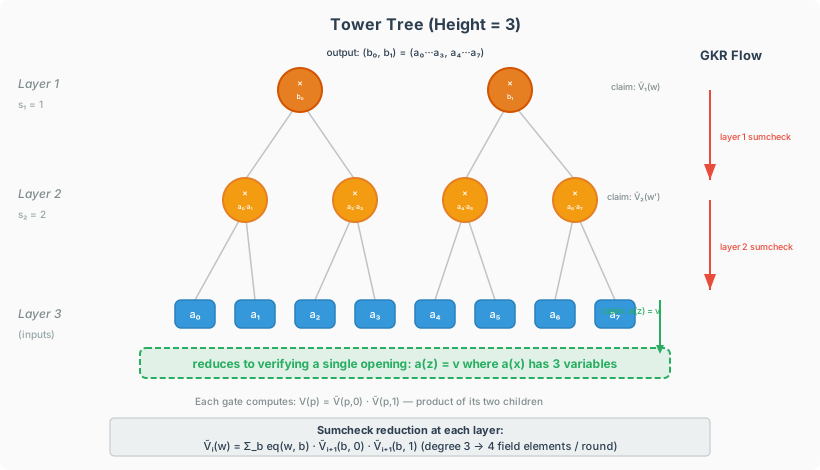
The following diagram shows a height-3 tower tree with 8 inputs, outputting $(b_0, b_1) = (a_0 \cdots a_3,; a_4 \cdots a_7)$:
Applying the GKR Protocol
The GKR protocol verifies the computation layer by layer, from the top down to the inputs. At each layer, the verifier holds a claim about the multilinear extension $\tilde{V}_i(w)$ for some random point $w$, and reduces it to a claim about $\tilde{V}_{i+1}(\omega)$ via a sumcheck invocation.
Claim reduction at each layer. Suppose the verifier holds a claim $\tilde{V}_i(w) = c$ for some random point $w$. Since every gate at layer $i$ multiplies its two children at layer $i+1$, the multilinear extension satisfies:
$$ \tilde{V}_i(w) = \sum_{b \in \{0,1\}^{s_i}} \textrm{eq}(w, b) \cdot \tilde{V}_{i+1}(b, 0) \cdot \tilde{V}_{i+1}(b, 1) $$
where $\tilde{V}_i$ and $\tilde{V}_{i+1}$ are the multilinear extensions of the gate values at layers $i$ and $i+1$ respectively, and $\textrm{eq}(w, b) = \prod_{k=1}^{s_i}(w_k b_k + (1 - w_k)(1 - b_k))$ is the multilinear extension of the equality function (equals 1 when $b = w$ on Boolean inputs).
The verifier reduces this claim by running the sumcheck protocol on the right-hand side. The summand $\textrm{eq}(w, b) \cdot \tilde{V}_{i+1}(b, 0) \cdot \tilde{V}_{i+1}(b, 1)$ has degree 3 in each variable of $b$ (one degree from $\textrm{eq}$, one from each $\tilde{V}_{i+1}$ factor). Therefore, each round of the sumcheck protocol requires the prover to send 4 field elements.
Full protocol flow (height-3 example):
- Start: The verifier has the claimed output $(b_0, b_1)$ and constructs a claim $\tilde{V}_1(w) = c$ at a random point $w$.
- Layer 1 sumcheck: Run sumcheck on $\sum_{b} \textrm{eq}(w, b) \cdot \tilde{V}_2(b, 0) \cdot \tilde{V}_2(b, 1)$. This reduces the claim to evaluations of $\tilde{V}_2$, which the verifier combines into a single claim $\tilde{V}_2(w’) = c’$ at a new random point $w’$.
- Layer 2 sumcheck: Run sumcheck on $\sum_{b} \textrm{eq}(w’, b) \cdot \tilde{V}_3(b, 0) \cdot \tilde{V}_3(b, 1)$. This reduces to a claim about $\tilde{V}_3$, i.e., an evaluation of the input multilinear polynomial $a(x)$ (with 3 variables) at a point $z$. The validity of $(b_0, b_1)$ is thus reduced to verifying a single evaluation/opening $a(z) = v$.
Tower trees in Ceno
In Ceno, tower trees are the backbone of offline memory checking: every memory read/write is verified by computing a grand product via a tower tree, and the GKR protocol proves this computation correct with a linear-time prover and a logarithmic-time verifier.
References
- Justin Thaler. Time-Optimal Interactive Proofs for Circuit Evaluation. 2013. Section 5.3.1: “The Polynomial for a Binary Tree”. Available at: https://eprint.iacr.org/2013/351.pdf