Architecture Overview
1. Multi-chip Architecture
Ceno is structured as a collection of chips, each a self-contained GKR circuit. A chip’s per-layer constraints are same-row gates: every gate is a low-degree polynomial identity among witness values at the same hypercube index, checked by a per-layer zerocheck. Ceno has no global row-rotation; multi-step computations are expressed in one of two ways:
- Unroll into a single row — stage every intermediate value as its own same-row witness. Works when the step count is small enough to fit as extra columns.
- Local rotation PIOP — the only cross-row mechanism. It links round $\mathbf{r}$ to round $g(\mathbf{r})$ along a $g$-orbit on $B_m$ (the “next” function from HyperPlonk). Used for round-based computations such as Keccak-f, where unrolling every round into a single row would be prohibitive.
Chips do not share witnesses directly — they interact through two mechanisms that are both reconciled by a single global LogUp tower.
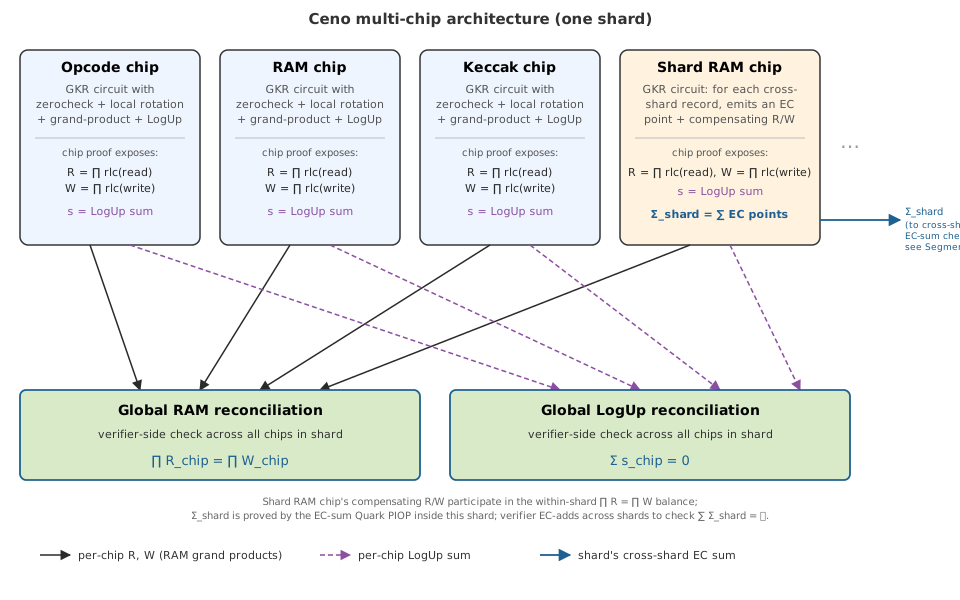
1. Shared RAM state (RAMType). Three logical address spaces are
exposed to every chip:
GlobalState— VM-wide state such as program counter and cycle counter.Register— RISC-V registers.Memory— main memory.
Each access is hashed to an extension-field element by random linear
combination (RLC) with the RAMType tag folded into the hash, so
entries from different regions cannot collide. Each chip’s GKR
circuit locally accumulates these hashes into a grand product
for reads and a grand product for writes:
$$ R = \prod_i \mathsf{rlc}(r_i), \qquad W = \prod_j \mathsf{rlc}(w_j), $$
and outputs both as part of the chip proof.
2. Cross-chip lookups. A chip that advertises a ROM-style table (e.g. the range check chip) can be queried by other chips. Each chip’s GKR circuit likewise locally accumulates its lookup contributions — tables it exposes and queries it issues — into a single fractional LogUp sum and outputs it as part of the chip proof.
Reconciliation. Two parallel mechanisms combine the per-chip outputs:
- Shared RAM state — the verifier checks that the product of every chip’s $R$ equals the product of every chip’s $W$. Each chip’s $R$ and $W$ are themselves proved correct by the GKR grand-product PIOP run inside that chip’s proof.
- Cross-chip lookups — the verifier checks that the per-chip LogUp fractional sums add up to zero across all chips. Each chip’s LogUp sum is itself proved correct by the GKR LogUp PIOP run inside that chip’s proof.
Both PIOPs run per-chip, inside each chip’s GKR proof, to establish that chip’s $R$, $W$, and LogUp sum. The global reconciliation is just a small verifier-side check on the per-chip outputs: $\prod R = \prod W$ across chips for RAM, and the sum of LogUp fractional sums across chips is zero for cross-chip lookups.
The main benefit of this split is prover peak memory: chips can be proved one at a time (or in small batches), so peak memory is bounded by the largest chip’s witness rather than the sum over all chips. Proving every chip simultaneously would hold every witness in memory at once.
One chip in the diagram — the shard RAM chip — is special: it participates in the within-shard $\prod R = \prod W$ balance like any other chip, but additionally emits a cross-shard EC accumulator $\Sigma_{\text{shard}}$ that is reconciled across shards rather than inside the shard. Its role is explained in the Segmentation section below.
2. Segmentation
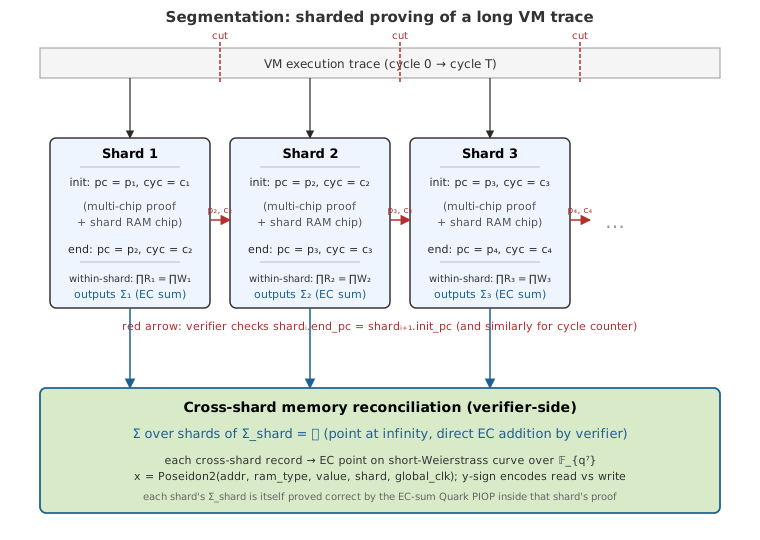
When a VM’s execution trace is too large to fit in a single shard, we split it along the cycle axis into multiple shards, each proved independently. The proof system must then check that the shards compose into a single consistent execution:
-
Control-flow continuity. Each shard exposes its initial and final
GlobalState(program counter, cycle counter, …) as public inputs, and the verifier checks $\text{shard}i.\text{end_pc} = \text{shard}{i+1}.\text{init_pc}$ (and likewise for otherGlobalStatefields) at every shard boundary. -
Dynamic heap/hint continuity. Shards also expose the start address and length of the dynamic heap and hint init regions. The verifier checks that these segments stay within the platform’s heap and hint windows and that each shard starts exactly where the previous shard ended, so dynamic init data cannot skip, overlap, or move out of range across shard boundaries. See Memory Continuation Checks.
-
Cross-shard memory consistency. Memory written in shard $i$ must remain readable in any later shard $j > i$. The within-shard RAM grand product $\prod R = \prod W$ cannot be reused across shards because each shard’s RLC challenge is sampled from its own Fiat-Shamir transcript, so per-shard products live in different random-hash scalings and cannot be combined.
The underlying idea is a homomorphic multiset digest: a map $H$ from multisets of memory records into an abelian group $(G, +)$ that is a monoid homomorphism — $H(S_1 \uplus S_2) = H(S_1) + H(S_2)$ and $H(\emptyset) = 0$ (the group identity). Homomorphism is what lets a global digest be assembled from per-shard digests by simple group addition, with no shared challenge. If $H$ is chosen so that a matched (write, later-read) pair digests to $0$, every matched pair cancels, and consistency across shards reduces to checking that the digest of the full cross-shard multiset equals $0$ — i.e. the digest of the empty multiset.
The standard recipe is to pick a per-record hash $h : \text{records} \to G$ and define $H(S) := \sum_{r \in S} h(r)$; homomorphism is then automatic. Ceno takes $G$ to be a short-Weierstrass curve $E$ over the septic extension $\mathbb{F}_{q^7}$, with $h$ a deterministic hash-to-curve: the $x$-coordinate is a Poseidon2 hash of $(\text{addr}, \text{ram_type}, \text{value}, \text{shard}, \text{global_clk})$, and the sign of $y$ encodes read vs write (writes take $y \in [p/2, p)$, reads take $y \in [0, p/2)$). A write and its matching future read hash to the same $x$ with opposite $y$, so they are additive inverses on $E$ and cancel under EC addition. Soundness rests on collision-resistance of Poseidon2 in the $x$-coordinate — two unrelated records shouldn’t accidentally hash to $\pm$ the same point. This EC-based cross-shard multiset-hash design is adapted from SP1, which introduced it for cross-shard memory consistency in its zkVM.
A dedicated shard RAM chip inside each shard’s proof ties the two layers together: for every memory read whose matching write lives in an earlier shard, it inserts a compensating local write (so the local RLC grand product still balances) and emits the corresponding EC point into the shard’s cross-shard accumulator $\Sigma_{\text{shard}}$; symmetrically for writes that will be read in a later shard. The EC-sum Quark PIOP runs inside each shard’s proof to establish that $\Sigma_{\text{shard}}$ equals the sum of those per-record EC points. The verifier then just EC-adds the per-shard $\Sigma_{\text{shard}}$ values and checks $\sum_{\text{shard}} \Sigma_{\text{shard}} = \mathcal{O}$ (the point at infinity) directly. The number of shards is at most in the hundreds, so this is a few hundred EC additions.